"Magnetic Resonance Imaging is used in for medical imaging. The procedure for an MRI is the following. Unlike an X ray examination or CT scan MRI does not depend on ionizing radiation. Instead while in the magnet, radio waves redirect the axes of spinning protons. The magnetic field is produced when electric currents are passed through wire coils. Other coils as side from these coils, located in the machine which are plased around the body being imaged recieves and sends radio waves. They then produce signals. A computer picks up these signals and generates a series of images. Thus the image can be studied. This is the basic sturture of how an MRI works. During the examination people must be still and some times asked to hold their breath by the docter. This is all procedures to can an accurate MRI."
How Magnetic Resonance Imaging Works
(Nuclear magnetic resonance imaging provides safe nonintrusive medical diagnostic images of the interior of the human body. How does MRI work?)
One of the many modern diagnostic tools available to medical doctors is magnetic resonance imaging (MRI). MRI scans provide physicians a view of the interior of the patient's body without harming or invading the patient's body in any way. Magnetic resonance imaging is based on the fundamental physics of nuclear magnetic resonance (NMR). How does MRI work?
Nuclear Magnetic Resonance
Nuclear magnetic resonance is an effect that occurs when the nucleus of an atom is placed in a magnetic field. The spinning nucleus in a constant magnetic field wobbles just like a spinning top.
If in addition to the constant magnetic field, there is another magnetic field that varies at the same frequency as the nucleus wobbles, the nucleus will flip back and forth so that the nucleus effectively alternates the direction in which it spins. As the nucleus flips its spin direction, it either absorbs or emits low energy radio waves. Studying these radio waves allows physicists to deduce various properties of the atomic nuclei undergoing NMR.
Safety of NMR and MRI
Nuclear magnetic resonance uses the word nuclear because it involves the nucleus of the atom. It does not however in any way involve any dangerous radiation as people expect from nuclear weapons or other nuclear reactions. The only radiation patients are exposed to by nuclear magnetic resonance imaging is very low energy radio waves. Nuclear magnetic resonance imaging is therefore very safe. The word nuclear was dropped however to allay patient fears. To the average person magnetic resonance imaging sounds less dangerous than nuclear magnetic resonance, and MRI is very safe.
Magnetic Resonance Imaging
Magnetic resonance imaging is a very useful application of NMR. Medical MRI machines are designed to image the nuclei of the hydrogen atoms in the human body. Human bodies contain a high percentage of water, so there are a large number of hydrogen atoms in all human tissue. X-rays image bones well, but image other tissues very poorly. Magnetic resonance imaging therefore provides medical personnel with much better images of the soft tissue in the patient's body than X-rays can provide.
This article was found from the cite (http://physics.suite101.com/article.cfm/how_magnetic_resonance_imaging_mri_works)
Friday, November 27, 2009

Kinetic Energy
Kinetic energy is very simple it is the energy of motion. Objects that contain no motion has kinetic energy. "The faster the body moves the greater the kinetic energy produced. Also the greater the mass and speed of an object the greater the kinetic energy will be" This was found from the website <http://library.thinkquest.org/2745/data/ke.htm>
There are different types of kinetic energy. First there is vibrational which is the energy due to vibrational motion. Secondly there is rotational which is the energy due to rotational motion. Lastly there is translational, the energy due to the motion from one location to another.
Potential Energy
"Potential energy is the same as stored energy. The "stored" energy is held within the gravitational field. When you lift a heavy object you exert energy which later will become kinetic energy when the object is dropped. A lift motor from a roller coaster exerts potential energy when lifting the train to the top of the hill. The higher the train is lifted by the motor the more potential energy is produced; thus, forming a greater amount if kinetic energy when the train is dropped. At the top of the hills the train has a huge amount of potential energy, but it has very little kinetic energy." <http://library.thinkquest.org/2745/data/ke.htm>
Links Related To Kinetic Energy:
http://en.wikipedia.org/wiki/Kinetic_energy
http://www.physicsclassroom.com/Class/energy/U5l1c.cfm
There are different types of kinetic energy. First there is vibrational which is the energy due to vibrational motion. Secondly there is rotational which is the energy due to rotational motion. Lastly there is translational, the energy due to the motion from one location to another.
Potential Energy
"Potential energy is the same as stored energy. The "stored" energy is held within the gravitational field. When you lift a heavy object you exert energy which later will become kinetic energy when the object is dropped. A lift motor from a roller coaster exerts potential energy when lifting the train to the top of the hill. The higher the train is lifted by the motor the more potential energy is produced; thus, forming a greater amount if kinetic energy when the train is dropped. At the top of the hills the train has a huge amount of potential energy, but it has very little kinetic energy." <http://library.thinkquest.org/2745/data/ke.htm>
Links Related To Kinetic Energy:
http://en.wikipedia.org/wiki/Kinetic_energy
http://www.physicsclassroom.com/Class/energy/U5l1c.cfm
Radiography

Radiography
Radiography is the creation of images by exposing a photographic film or other image receptor to X-rays.
Since X-rays penetrate solid objects, but are weakened by them depending on the object's composition, the resulting picture reveals the internal structure of the object.
The most common use of radiography is in the medical field (where it is known as medical imaging), but veterinarians and engineers also use it..
<http://www.sciencedaily.com/articles/r/radiography.htm>
"Radiography is the use of X rays to view objects. It has been a big advancement in medical viewing. As said above radiography is used in the medical field but it is also used in the industrial field. Radiography was founded the same time X rays were discovered. X rays as we know are electromagnetic waves that do not require a medium to go through. This was learnt during our unit in physics on waves. From researching various cites i have found that radiography started in 1895. Radiography is very simple, all it is is the imaging of objects."
Radiography is the creation of images by exposing a photographic film or other image receptor to X-rays.
Since X-rays penetrate solid objects, but are weakened by them depending on the object's composition, the resulting picture reveals the internal structure of the object.
The most common use of radiography is in the medical field (where it is known as medical imaging), but veterinarians and engineers also use it..
<http://www.sciencedaily.com/articles/r/radiography.htm>
"Radiography is the use of X rays to view objects. It has been a big advancement in medical viewing. As said above radiography is used in the medical field but it is also used in the industrial field. Radiography was founded the same time X rays were discovered. X rays as we know are electromagnetic waves that do not require a medium to go through. This was learnt during our unit in physics on waves. From researching various cites i have found that radiography started in 1895. Radiography is very simple, all it is is the imaging of objects."
Speed of Sound
Speed of sound
The speed of sound is a term used to describe the speed of sound waves passing through an elastic medium.
The speed varies with the medium employed (for example, sound waves move faster through water than through air), as well as with the properties of the medium, especially temperature.
The term is commonly used to refer specifically to the speed of sound in air.
At sea level, at a temperature of 21 degrees Celsius (70 degrees Fahrenheit) and under normal atmospheric conditions, the speed of sound is 344 m/s (1238 km/h or 770 mph).
The speed varies depending on atmospheric conditions; the most important factor is the temperature.
Humidity has little effect on the speed of sound, nor does air pressure by itself. Air pressure has no effect at all in an ideal gas approximation.
This is because pressure and density both contribute to sound velocity equally, and in an ideal gas the two effects cancel out, leaving only the effect of temperature.Sound usually travels more slowly with greater altitude, due to reduced temperature..
The information provided was found from the website (http://www.sciencedaily.com/articles/s/speed_of_sound.htm)
"The speed of sound is something we learned during our unit on waves. The speed of sound is the disturbance through a medium. The speed of sound is different through different types of objects or substances. For example the speed of sound of air depends among the properties in air. It differs that from the speed of sound through various types of materials such as solids. The speed of sound in solids is greater then that of liquids. The speed of sounds in liquids is greater then that of gases. The speed of sound is one aspect we learned about when we took up our unit on waves. These were the different properties and aspects assosaited with the speed of sound."
The speed of sound is a term used to describe the speed of sound waves passing through an elastic medium.
The speed varies with the medium employed (for example, sound waves move faster through water than through air), as well as with the properties of the medium, especially temperature.
The term is commonly used to refer specifically to the speed of sound in air.
At sea level, at a temperature of 21 degrees Celsius (70 degrees Fahrenheit) and under normal atmospheric conditions, the speed of sound is 344 m/s (1238 km/h or 770 mph).
The speed varies depending on atmospheric conditions; the most important factor is the temperature.
Humidity has little effect on the speed of sound, nor does air pressure by itself. Air pressure has no effect at all in an ideal gas approximation.
This is because pressure and density both contribute to sound velocity equally, and in an ideal gas the two effects cancel out, leaving only the effect of temperature.Sound usually travels more slowly with greater altitude, due to reduced temperature..
The information provided was found from the website (http://www.sciencedaily.com/articles/s/speed_of_sound.htm)
"The speed of sound is something we learned during our unit on waves. The speed of sound is the disturbance through a medium. The speed of sound is different through different types of objects or substances. For example the speed of sound of air depends among the properties in air. It differs that from the speed of sound through various types of materials such as solids. The speed of sound in solids is greater then that of liquids. The speed of sounds in liquids is greater then that of gases. The speed of sound is one aspect we learned about when we took up our unit on waves. These were the different properties and aspects assosaited with the speed of sound."
Microwaves!!
Microwaves are electromagnetic waves with wavelengths longer than those of terahertz (THz) wavelengths, but relatively short for radio waves.
Microwaves have wavelengths approximately in the range of 30 cm (frequency = 1 GHz) to 1 mm (300 GHz).
However, the boundaries between far infrared light, terahertz radiation, microwaves, and ultra-high-frequency radio waves are fairly arbitrary and are used variously between different fields of study.
A microwave oven works by passing microwave radiation, usually at a frequency of 2450 MHz (a wavelength of 12.24 cm), through the food.
Water, fat, and sugar molecules in the food absorb energy from the microwave beam in a process called dielectric heating.
Many molecules (such as those of water) are electric dipoles, meaning that they have a positive charge at one end and a negative charge at the other, and therefore rotate as they try to align themselves with the alternating electric field induced by the microwave beam.
This molecular movement creates heat as the rotating molecules hit other molecules and put them into motion.
Microwave heating is most efficient on liquid water, and much less so on fats and sugars (which have less molecular dipole moment), and frozen water (where the molecules are not free to rotate)..
The information provided was found from the websited (http://www.sciencedaily.com/articles/matter_energy/physics/)
Microwaves have wavelengths approximately in the range of 30 cm (frequency = 1 GHz) to 1 mm (300 GHz).
However, the boundaries between far infrared light, terahertz radiation, microwaves, and ultra-high-frequency radio waves are fairly arbitrary and are used variously between different fields of study.
A microwave oven works by passing microwave radiation, usually at a frequency of 2450 MHz (a wavelength of 12.24 cm), through the food.
Water, fat, and sugar molecules in the food absorb energy from the microwave beam in a process called dielectric heating.
Many molecules (such as those of water) are electric dipoles, meaning that they have a positive charge at one end and a negative charge at the other, and therefore rotate as they try to align themselves with the alternating electric field induced by the microwave beam.
This molecular movement creates heat as the rotating molecules hit other molecules and put them into motion.
Microwave heating is most efficient on liquid water, and much less so on fats and sugars (which have less molecular dipole moment), and frozen water (where the molecules are not free to rotate)..
The information provided was found from the websited (http://www.sciencedaily.com/articles/matter_energy/physics/)
"As stated in the above article I've learned that microwaves are electromagnetic waves. Electromagnetic waves are waves that do not require a medium to go through. Microwaves are very good at transmitting information from one place to another. This is one used of microwaves. Another used microwaves have are that shorter microwaves are used in remote sensing. An example of this is weather forecasting. The most commom used of microwaves are those of microwave ovens or the kitchen appliance microwaves. The microwave radiation heats the water molecules within food. This results in the heating of your food but not completely baking your food. One interesting fact about microwaves were that they were first discovered in the 1940's."
Friday, November 20, 2009
The Discovery of X Rays
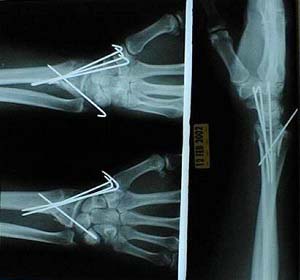
Links Related to X Rays
http://www.nlm.nih.gov/medlineplus/ency/article/003337.htm
http://en.wikipedia.org/wiki/X-ray
X Rays
As the wavelengths of light decrease, they increase in energy. X-rays have smaller wavelengths and therefore higher energy than ultraviolet waves. We usually talk about X-rays in terms of their energy rather than wavelength. This is partially because X-rays have very small wavelengths. It is also because X-ray light tends to act more like a particle than a wave. X-ray detectors collect actual photons of X-ray light.
X-rays were first observed and documented in 1895 by Wilhelm Conrad Roentgen, a German scientist who found them quite by accident when experimenting with vacuum tubes.
A week later, he took an X-ray photograph of his wife's hand which clearly revealed her wedding ring and her bones. The photograph electrified the general public and aroused great scientific interest in the new form of radiation. Roentgen called it "X" to indicate it was an unknown type of radiation. The name stuck, although (over Roentgen's objections), many of his colleagues suggested calling them Roentgen rays. The information provided was found from the website "http://science.hq.nasa.gov/kids/imagers/ems/xrays.html".
"This information was relevent to the class we took on waves. An X ray is an electral magnetic wave. It does not require a medium to go through. Unlike that of a mechanical wave, which requires a medium to go through. The invention of the X ray was a big advancement in the medical field. It allows doctors to see the stucture of human bones, and its purpose is for medical imaging. The photograph from an X ray can tell if a persons bone is crack, fractured, or broken in any shape or form. X rays are also used for angiography which is the studies of hollow organs. The invention of X rays has better the technology that for medical imaging. This is an example of the field X rays are used."
http://www.nlm.nih.gov/medlineplus/ency/article/003337.htm
http://en.wikipedia.org/wiki/X-ray
X Rays
As the wavelengths of light decrease, they increase in energy. X-rays have smaller wavelengths and therefore higher energy than ultraviolet waves. We usually talk about X-rays in terms of their energy rather than wavelength. This is partially because X-rays have very small wavelengths. It is also because X-ray light tends to act more like a particle than a wave. X-ray detectors collect actual photons of X-ray light.
X-rays were first observed and documented in 1895 by Wilhelm Conrad Roentgen, a German scientist who found them quite by accident when experimenting with vacuum tubes.
A week later, he took an X-ray photograph of his wife's hand which clearly revealed her wedding ring and her bones. The photograph electrified the general public and aroused great scientific interest in the new form of radiation. Roentgen called it "X" to indicate it was an unknown type of radiation. The name stuck, although (over Roentgen's objections), many of his colleagues suggested calling them Roentgen rays. The information provided was found from the website "http://science.hq.nasa.gov/kids/imagers/ems/xrays.html".
"This information was relevent to the class we took on waves. An X ray is an electral magnetic wave. It does not require a medium to go through. Unlike that of a mechanical wave, which requires a medium to go through. The invention of the X ray was a big advancement in the medical field. It allows doctors to see the stucture of human bones, and its purpose is for medical imaging. The photograph from an X ray can tell if a persons bone is crack, fractured, or broken in any shape or form. X rays are also used for angiography which is the studies of hollow organs. The invention of X rays has better the technology that for medical imaging. This is an example of the field X rays are used."
Nuclear Energy

"Nuclear energy is power generated form nuclear reactions which are a collision of nuclear particles. Nuclear energy provides 2.1 percent of the worlds energy and 15 percent of the worlds electricity. From my research on nuclear energy an interesting fact about this subject is that in 2007 three years earlier there were 439 nuclear power reactors operating in the world. These nuclear power reactors occupied in 31 countries. Nuclear reactors work on the principle of nuclear fission. In nuclear fission the nuclei of atoms are split causing energy to be released."
Pros -
1. Little Pollution
As demand for electricity soars, the pollution produced from fossil fuel-burning plants is heading towards dangerous levels. Coal, gas and oil burning power plants are already responsible for half of America's air pollution. Burning coal produces carbon dioxide, which depletes the protection of the ozone. The soft coal, which many power plants burn, contains sulfur When the gaseous byproducts are absorbed in clouds, precipitation becomes sulfuric acid.. Coal also contains radioactive material. A coal-fired power plant emits more radiation into the air than a nuclear power plant. The world's reserves of fossil fuels are running out. The sulfurous coal which many plants use is more polluting than the coal that was previously used. Most of the anthracite, which plants also burn, has been used up. As more soft coal is used, the amount of pollution will increase. According to estimates, fossil fuels will be burned up within fifty years. There are large reserves of uranium, and new breeder reactors can produce more fuel than they use. Unfortunately this doesn't mean we can have an endless supply of fuel Breeder reactors need a feedstock of uranium and thorium, so when we run out of these two fuels (in about 1000 years), breeder reactors will cease to be useful. This is still a more lengthy solution to the current burning of coal, gas, and oil.
2. Reliability
Nuclear power plants need little fuel, so they are less vulnerable to shortages because of strikes or natural disasters. International relations will have little effect on the supply of fuel to the reactors because uranium is evenly deposited around the globe. One disadvantage of uranium mining is that it leaves the residues from chemical processing of the ore, which leads to radon exposure to the public. These effects do not outweigh the benefits by the fact that mining uranium out of the ground reduces future radon exposures. Coal burning leaves ashes that will increase future radon exposures. The estimates of radon show that it is safer to use nuclear fuel than burn coal. Mining of the fuel required to operate a nuclear plant for one year will avert a few hundred deaths, while the ashes from a coal-burning plant will cause 30 deaths.
3. Safety
Safety is both a pro and con, depending on which way you see it. The results of a compromised reactor core can be disastrous, but the precautions that prevent this from happening prevent it well. Nuclear power is one the safest methods of producing energy. Each year, 10,000 to 50,000 Americans die from respiratory diseases due to the burning of coal, and 300 are killed in mining and transportation accidents. In contrast, no Americans have died or been seriously injured because of a reactor accident or radiation exposure from American nuclear power plants. There are a number of safety mechanisms that make the chances of reactor accidents very low. A series of barriers separates the radiation and heat of the reactor core from the outside. The reactor core is contained within a 9-inch thick steel pressure vessel. The pressure vessel is surrounded by a thick concrete wall. This is inside a sealed steel containment structure, which itself is inside a steel-reinforced concrete dome four feet thick. The dome is designed to withstand extremes such as earthquakes or a direct hit by a crashing airliner. There is also a large number of sensors that pick up increases in radiation or humidity. An increase in radiation or humidity could mean there is a leak. There are systems that control and stop the chain reaction if necessary. An Emergency Core Cooling System ensures that in the event of an accident there is enough cooling water to cool the reactor.
Cons -
1. Meltdowns
If there is a loss of coolant water in a fission reactor, the rods would overheat. The rods that contain the uranium fuel pellets would dissolve, leaving the fuel exposed. The temperature would increase with the lack of a cooling source. When the fuel rods heat to 2800°C, the fuel would melt, and a white-hot molten mass would melt its way through the containment vessels to the ground below it. This is a worst case scenario, as there are many precautions taken to avoid this. Emergency water reservoirs are designed to immediately flood the core in the case of sudden loss of coolant. There are normally multiple sources of water to draw from, as the low pressure injection pumps, containment spray system, and refueling pumps are all potentially available, and all draw water from different sources. The disaster at Three Mile Island was classified as a partial meltdown, caused by the failure to supply coolant to the core. Although the core was completely destroyed, the radioactive mass never penetrated the steel outlining the containment structure. Several feet of special concrete, a standard precaution, was capable of preventing leakage for several hours, giving operators enough time to fix the flooding system of the reactor core. The worst case of a nuclear disaster was in 1986 at the Chernobyl facility in the Ukraine. A fire ripped apart the casing of the core, releasing radioactive isotopes into the atmosphere. Thirty-one people died as an immediate result. And estimated 15,000 more died in the surrounding area after exposure to the radiation. Three Mile Island and Chernobyl are just examples of the serious problems that meltdowns can create.
2. Radiation
Radiation doses of about 200 rems cause radiation sickness, but only if this large amount of radiation is received all at once. The average person receives about 200 millirems a year from everyday objects and outer space. This is referred to as background radiation. If all our power came from nuclear plants we would receive an extra 2/10 of a millirem a year. The three major effects of radiation (cancer, radiation sickness and genetic mutation) are nearly untraceable at levels below about 50 rems. In a study of 100,000 survivors of the atomic bombs dropped on Hiroshima and Nagasaki, there have been 400 more cancer deaths than normal, and there is not an above average rate of genetic disease in their children. During the accident at Three Mile Island in America, people living within a 50 mile radius only received an extra 3/10 of one percent of their average annual radiation. This was because of the containment structures, the majority of which were not breached. The containment building and primary pressure vessel remained undamaged, fulfilling their function.
3. Waste Disposal
The byproducts of the fissioning of uranium-235 remains radioactive for thousands of years, requiring safe disposal away from society until they lose their significant radiation values. Many underground sites have been constructed, only to be filled within months. Storage facilities are not sufficient to store the world’s nuclear waste, which limits the amount of nuclear fuel that can be used per year. Transportation of the waste is risky, as many unknown variables may affect the containment vessels. If one of these vessels were compromised, the results may be deadly.
The information provided in this blog was from the website "http://members.tripod.com/funk_phenomenon/nuclear/procon.htm"
Pros -
1. Little Pollution
As demand for electricity soars, the pollution produced from fossil fuel-burning plants is heading towards dangerous levels. Coal, gas and oil burning power plants are already responsible for half of America's air pollution. Burning coal produces carbon dioxide, which depletes the protection of the ozone. The soft coal, which many power plants burn, contains sulfur When the gaseous byproducts are absorbed in clouds, precipitation becomes sulfuric acid.. Coal also contains radioactive material. A coal-fired power plant emits more radiation into the air than a nuclear power plant. The world's reserves of fossil fuels are running out. The sulfurous coal which many plants use is more polluting than the coal that was previously used. Most of the anthracite, which plants also burn, has been used up. As more soft coal is used, the amount of pollution will increase. According to estimates, fossil fuels will be burned up within fifty years. There are large reserves of uranium, and new breeder reactors can produce more fuel than they use. Unfortunately this doesn't mean we can have an endless supply of fuel Breeder reactors need a feedstock of uranium and thorium, so when we run out of these two fuels (in about 1000 years), breeder reactors will cease to be useful. This is still a more lengthy solution to the current burning of coal, gas, and oil.
2. Reliability
Nuclear power plants need little fuel, so they are less vulnerable to shortages because of strikes or natural disasters. International relations will have little effect on the supply of fuel to the reactors because uranium is evenly deposited around the globe. One disadvantage of uranium mining is that it leaves the residues from chemical processing of the ore, which leads to radon exposure to the public. These effects do not outweigh the benefits by the fact that mining uranium out of the ground reduces future radon exposures. Coal burning leaves ashes that will increase future radon exposures. The estimates of radon show that it is safer to use nuclear fuel than burn coal. Mining of the fuel required to operate a nuclear plant for one year will avert a few hundred deaths, while the ashes from a coal-burning plant will cause 30 deaths.
3. Safety
Safety is both a pro and con, depending on which way you see it. The results of a compromised reactor core can be disastrous, but the precautions that prevent this from happening prevent it well. Nuclear power is one the safest methods of producing energy. Each year, 10,000 to 50,000 Americans die from respiratory diseases due to the burning of coal, and 300 are killed in mining and transportation accidents. In contrast, no Americans have died or been seriously injured because of a reactor accident or radiation exposure from American nuclear power plants. There are a number of safety mechanisms that make the chances of reactor accidents very low. A series of barriers separates the radiation and heat of the reactor core from the outside. The reactor core is contained within a 9-inch thick steel pressure vessel. The pressure vessel is surrounded by a thick concrete wall. This is inside a sealed steel containment structure, which itself is inside a steel-reinforced concrete dome four feet thick. The dome is designed to withstand extremes such as earthquakes or a direct hit by a crashing airliner. There is also a large number of sensors that pick up increases in radiation or humidity. An increase in radiation or humidity could mean there is a leak. There are systems that control and stop the chain reaction if necessary. An Emergency Core Cooling System ensures that in the event of an accident there is enough cooling water to cool the reactor.
Cons -
1. Meltdowns
If there is a loss of coolant water in a fission reactor, the rods would overheat. The rods that contain the uranium fuel pellets would dissolve, leaving the fuel exposed. The temperature would increase with the lack of a cooling source. When the fuel rods heat to 2800°C, the fuel would melt, and a white-hot molten mass would melt its way through the containment vessels to the ground below it. This is a worst case scenario, as there are many precautions taken to avoid this. Emergency water reservoirs are designed to immediately flood the core in the case of sudden loss of coolant. There are normally multiple sources of water to draw from, as the low pressure injection pumps, containment spray system, and refueling pumps are all potentially available, and all draw water from different sources. The disaster at Three Mile Island was classified as a partial meltdown, caused by the failure to supply coolant to the core. Although the core was completely destroyed, the radioactive mass never penetrated the steel outlining the containment structure. Several feet of special concrete, a standard precaution, was capable of preventing leakage for several hours, giving operators enough time to fix the flooding system of the reactor core. The worst case of a nuclear disaster was in 1986 at the Chernobyl facility in the Ukraine. A fire ripped apart the casing of the core, releasing radioactive isotopes into the atmosphere. Thirty-one people died as an immediate result. And estimated 15,000 more died in the surrounding area after exposure to the radiation. Three Mile Island and Chernobyl are just examples of the serious problems that meltdowns can create.
2. Radiation
Radiation doses of about 200 rems cause radiation sickness, but only if this large amount of radiation is received all at once. The average person receives about 200 millirems a year from everyday objects and outer space. This is referred to as background radiation. If all our power came from nuclear plants we would receive an extra 2/10 of a millirem a year. The three major effects of radiation (cancer, radiation sickness and genetic mutation) are nearly untraceable at levels below about 50 rems. In a study of 100,000 survivors of the atomic bombs dropped on Hiroshima and Nagasaki, there have been 400 more cancer deaths than normal, and there is not an above average rate of genetic disease in their children. During the accident at Three Mile Island in America, people living within a 50 mile radius only received an extra 3/10 of one percent of their average annual radiation. This was because of the containment structures, the majority of which were not breached. The containment building and primary pressure vessel remained undamaged, fulfilling their function.
3. Waste Disposal
The byproducts of the fissioning of uranium-235 remains radioactive for thousands of years, requiring safe disposal away from society until they lose their significant radiation values. Many underground sites have been constructed, only to be filled within months. Storage facilities are not sufficient to store the world’s nuclear waste, which limits the amount of nuclear fuel that can be used per year. Transportation of the waste is risky, as many unknown variables may affect the containment vessels. If one of these vessels were compromised, the results may be deadly.
The information provided in this blog was from the website "http://members.tripod.com/funk_phenomenon/nuclear/procon.htm"
Subscribe to:
Posts (Atom)